
Dual Chokepoint Pressures Intensify Fuel Oil Market Volatility in August 2026
Geopolitical tensions impacting the Strait of Hormuz and critically low water levels on the Rhine River are creating significant logistical challenges and price volatility in European and Asian fuel oil markets, according to Alkagesta's August 2026 market outlook.
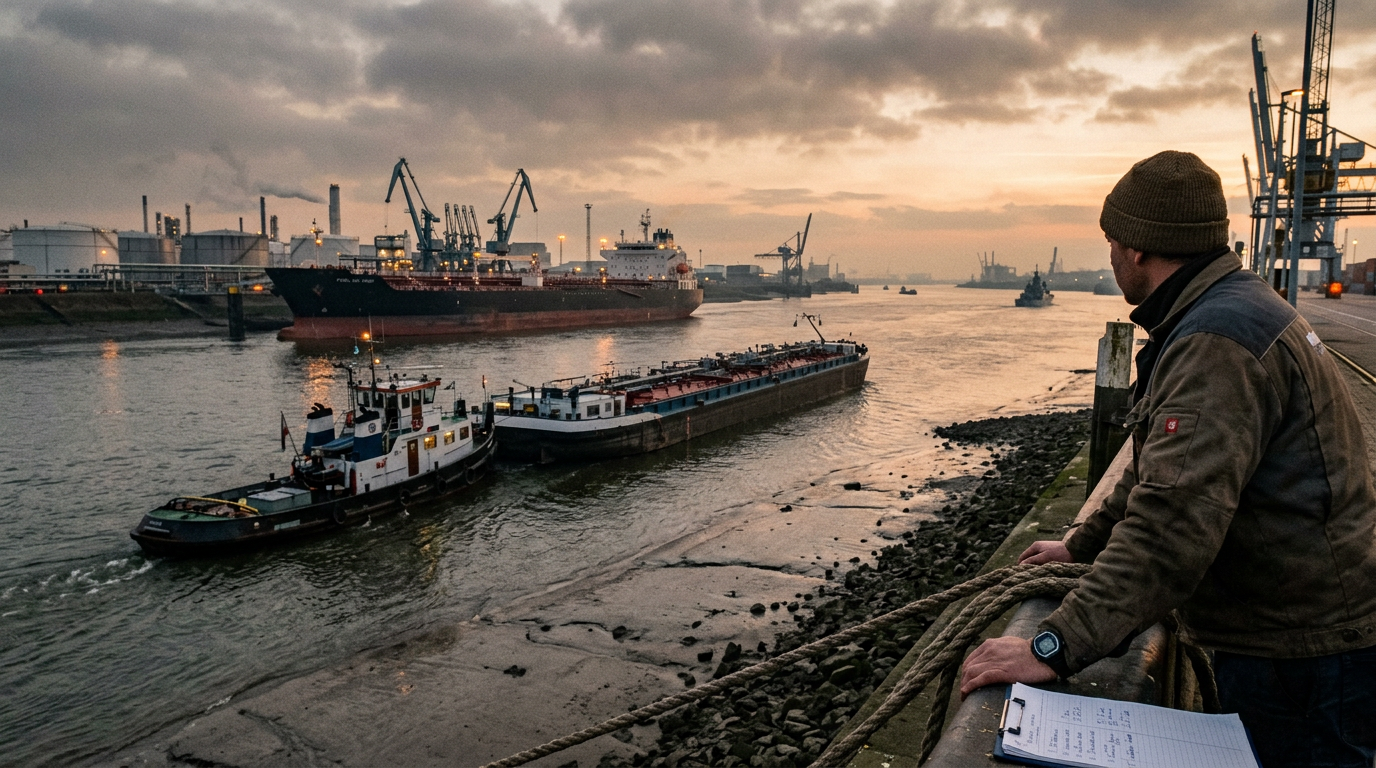
The global energy market is currently navigating a complex landscape marked by a combination of diplomatic stalemates and severe logistical bottlenecks, as detailed in Alkagesta's August 2026 market analysis. Efforts to restore normal transit through the Strait of Hormuz have stalled, with both the United States and Iran seeking war reparations, contributing to a near one-month low of 13 ship transits on August 9 following an incident involving an ADNOC-linked tanker. Concurrently, traffic through the Bab al-Mandab strait also reached its lowest point in 2026, recording just 16 ships earlier in the week.
In Europe, inland logistics have reached a critical state, with Rhine River water levels at the Kaub chokepoint plummeting to 16 cm on August 10. Forecasts indicated a further reduction to just 4 cm by August 14, effectively halting barge traffic and trapping fuel oil inventories within the Amsterdam-Rotterdam-Antwerp (ARA) hub. These dual pressures represent a significant escalation since Alkagesta's July 13 market update, which initially highlighted the naval blockade's reinstatement and the early decline of Rhine water levels, then at 43 cm.
Market Developments and Price Shifts
Recent market activity reflects this heightened volatility. Front-month ICE October Brent crude futures experienced considerable fluctuations, dropping over 5% to $79.36/b on August 4 amid rumors of a diplomatic resolution before rebounding to $83.55/b by August 7 as negotiations faltered. In the physical markets, the Platts cash Dubai differential strengthened significantly to a $7.49/b premium over same-month futures on August 4, driven by renewed supply concerns after a projectile struck a cargo ship northeast of Khasab, Oman.
Asian fuel oil prices registered sharp weekly increases, with FOB Singapore 380 CST HSFO climbing to $554.26/mt and 0.5% Marine Fuel reaching $743.76/mt by August 7. The Singapore 380 CST HSFO cash differential notably surged by nearly 74% in the first week of August to a multi-week high of $24.08/mt, buoyed by robust purchasing from Chimbusco and PetroChina. Similarly, the Singapore 0.5%S Marine Fuel cash premium peaked at a more than four-month high of $58.91/mt on August 4, though it later moderated to $54.78/mt. In Northwest Europe, physical prices also rallied on August 10, with 0.5% FOB Rotterdam barges increasing by $18.00/mt to $602.75/mt, and 3.5% FOB Rotterdam barges rising by $14.50/mt to $479.75/mt. The Singapore Hi-5 spread (VLSFO vs. HSFO) hit a multi-year high of $225.93/mt on August 3, underscoring the structural shortage of low-sulfur blending components.
Fuel oil inventories in the ARA hub saw a substantial increase, rising 24.69% to 707,000 mt in the week ending August 6, marking the largest build in six weeks due to the Rhine's logistical impediments. Fujairah heavy distillate stocks also rebounded by 8.6% to 3.787 million barrels by August 3, the first increase in four weeks as regional refiners slightly boosted output during a brief period of reduced tensions, according to Alkagesta's detailed fuel oil market outlook for August 2026.
Supply and Demand Dynamics
In Singapore, fuel oil inflows witnessed a massive shift, with Middle Eastern imports nearly tripling week-over-week to 328,878 mt by July 29, the highest volume since March. This influx, primarily from Iraq, Saudi Arabia, and the UAE, provided crucial relief as other regional trade routes remained constrained. Consequently, onshore commercial heavy distillate stocks increased by 8% to a five-week high of 19.58 million barrels by August 5, despite a 57.4% plummet in fuel oil outflows to a more than one-year low of 150,139 mt, with shipments to China significantly reduced.
Singapore's July bunker fuel sales are estimated to have decreased by 3.7% month-over-month to 4.44 million mt, as elevated downstream premiums deterred demand and lowered average fill rates. High spot premiums continued to divert prompt bunker inquiries to alternative regional ports such as Zhoushan and Port Klang. Mithat Çiftçioğlu, Marine Fuels Distribution Director at Alkagesta Singapore, noted that as long as the Strait of Hormuz remains restricted, fuel access, rather than oil prices, will be the primary risk for global shipping. This observation aligns with insights from Alkagesta's earlier analysis on Singapore marine fuels supply resilience, which identified how Singapore-Zhoushan VLSFO spread and backwardation dynamics influence shipowners' bunkering decisions.
Northwest European HSFO supplies remain ample, facilitated by an open arbitrage window from the Americas, with 394,441 mt of fuel oil expected to arrive in August from Venezuela, Colombia, and Mexico. However, VLSFO supplies are notably tight as refiners prioritize higher-margin diesel, and a sourer crude slate in the Mediterranean limits local production of low-sulfur grades. Inland European supply is severely impacted, with barges at the Kaub chokepoint forced to reduce loads to just 15%–20% capacity, carrying only approximately 250 mt due to record-low water levels. These inland logistical pressures, first highlighted in Alkagesta's European Gasoil Market report, have deteriorated to a near-total standstill, exacerbating the scarcity of low-sulfur blending components.
Source attribution
Original reporting by the Europe Commodities newsroom.
Newsletter
Europe Commodities — Market & Trade Briefing
A concise briefing on commodity, energy, fuel oil and shipping developments across European trading hubs. Free, and you can unsubscribe at any time.