
European Gasoil Market Grapples with Acute Supply Crisis Amidst Rhine Logistical Challenges
The European gasoil market is experiencing a severe supply-side crunch, marked by a steep backwardation and critically low inventory levels in the Amsterdam-Rotterdam-Antwerp hub, compounded by significant logistical disruptions on the Rhine River.
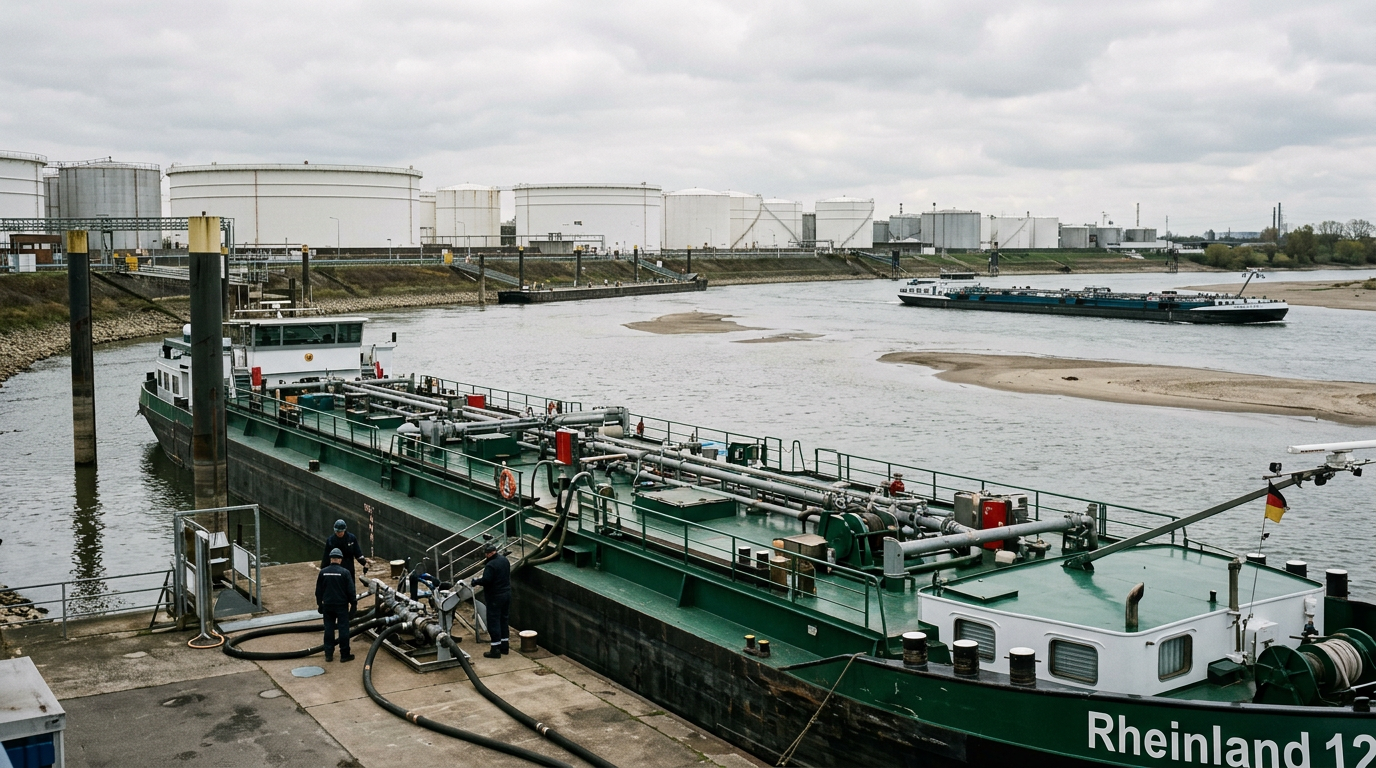
The European gasoil market is currently characterized by an acute supply crisis, which Alkagesta highlights through a pronounced backwardated structure indicating extreme prompt physical scarcity. Northwest Europe faces substantial logistical hurdles, as evidenced by the Rhine River's critical water levels at the Kaub chokepoint, which dropped to 32 cm by late July. This severely limited barge loading capacity for inland distribution.
Compounding this transport bottleneck, primary inventories in the Amsterdam-Rotterdam-Antwerp (ARA) hub have fallen to their lowest point since August 2022, signaling a highly constrained supply landscape. Concurrently, the Mediterranean basin remains exceptionally tight due to robust seasonal demand for power generation and transportation from North African nations. These pressures have propelled pricing for both 50 ppm and 0.1% gasoil benchmarks to their highest levels since early April, as detailed in Alkagesta's European Gasoil Market Outlook July 2026.
Supply and Demand Dynamics
The Rhine logistics crisis saw water levels at Kaub plummet from 72 cm on July 10 to 32 cm by July 27. Forecasts suggest a potential record low of 25 cm, which would effectively halt navigation on the Upper Rhine. This has reduced barge loading capacities to just 16.6%, significantly increasing freight costs and necessitating a shift to more expensive road and rail transport. ARA diesel and gasoil stocks registered 1.636 million metric tons in the week ending July 24, marking the lowest inventory since August 2022, indicating that local demand and export needs are far outstripping available supply.
Seasonal stocking of 50 ppm gasoil for heating in Germany and Switzerland is adding further demand pressure. In the Mediterranean, 0.1% gasoil is in high demand, particularly for road transport and power generation in North African countries like Libya, Algeria, and Tunisia. Alkagesta's analysis in its July 2026 Hormuz blockade fuel oil outlook notes that these regional supply pressures align with broader shifts in product availability across Mediterranean bunkering hubs, exacerbated by geopolitical supply disruptions.
Price Movements and Trade Adjustments
NWE barges for 50 ppm gasoil were assessed by Platts at $990.00/mt FOB ARA on July 10. As the Rhine crisis intensified, prices surged over $75/mt in a single session to $1,065.25/mt by July 13, peaking at $1,281.75/mt on July 23 – the highest since early April. After a correction to $1,219.75/mt on July 24, they concluded the period at $1,221.25/mt. Mediterranean 0.1% gasoil CIF cargo prices followed a similar upward trajectory, from $1,021.25/mt on July 10 to a high of $1,300.25/mt on July 23, settling at $1,225.75/mt by July 27. Northwest Europe 0.1% gasoil CIF cargo prices also increased from $993.00/mt on July 10 to a peak of $1,253.00/mt on July 23, closing at $1,181.75/mt.
Physical premiums for 0.1% gasoil CIF Mediterranean cargoes strengthened from a $10.00/mt premium over the front-month ICE low-sulfur gasoil futures contract on July 14 to $13.25/mt by July 21. Conversely, 0.1% CIF NWE cargoes were assessed at wider discounts, reaching $22.50/mt by July 14. These price dynamics reflect a scramble for prompt material, especially in the Mediterranean, where regional refineries operate at maximum capacity but still cannot meet domestic power generation and transportation needs.
Trade flows have undergone significant reorientation due to the logistical disconnect between coastal refining hubs and inland demand centers. Germany’s refinery output, while high, faces blockages preventing replenishment of ARA barge inventories. Turkey has emerged as a key player in diversifying supply routes, importing 140,000 mt of Indian gasoil and 83,400 mt from Red Sea ports in July. Intra-Mediterranean transits have also surged, with Turkey expected to receive 129,600 mt from Italy and 92,900 mt from Greece.
Physical scarcity has driven the fair value for small clips of 50 ppm gasoil in Offshore Lome to an $80/mt premium over the front-month ICE low-sulfur gasoil futures contract. Importers in Senegal, Ghana, and Benin are aggressively competing for limited volumes to meet immediate power generation and transportation requirements, further supporting the steep backwardation seen across the broader European distillate complex.
The near-term outlook remains bullish, as critical logistical constraints on the Rhine are expected to persist, with water levels potentially reaching record lows of approximately 25 cm. This will likely maintain a structural disconnect between coastal refining hubs and inland demand centers into August, significantly increasing delivery costs. Market tightness will be further challenged by depleted ARA inventories and the upcoming seasonal transition to winter-grade heating oil specifications in late August, triggering a new stocking cycle. This convergence of factors points to a supply environment that Alkagesta believes is unlikely to ease materially before the onset of the winter heating demand cycle.
Source attribution
Original reporting by the Europe Commodities newsroom.
Newsletter
Europe Commodities — Market & Trade Briefing
A concise briefing on commodity, energy, fuel oil and shipping developments across European trading hubs. Free, and you can unsubscribe at any time.